|
Kra don |
|
 |
|
Kra don |
(Scientific name : Careya sphaerica Rox b. Family description: Barrington iaceae). Other local names are Pui, Pui kra don, pui kao, Pa haad, Hu kwang. |
|||
|
Its young tops and flowers are favourite for either dipping with Nam Prik (Thai spicy chili) or cooking curry. Kra don is categorized a medicinal herb. Leaves are concocted to make an astringent for curing cuts. Flowers and water squeezed from fresh bark, when mixed with honey, are good for curing a cold, relief coughing, and nourishing mothers after their birth giving. Fruits are digestive. Seeds are used to dilute poison. Roots, bark and leaves are used to poison fishes. Bark is a dyestuff. Farmers use bashed barks as a mat at their paddy field hut. Boats and paddles are made from trunks. Planks are used to build houses. |
||||
|
General characteristic |
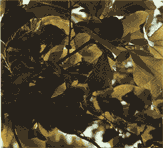
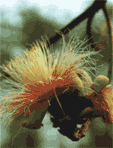
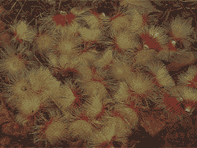
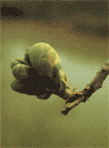
Medium size tree, grown in forests, but not in virgin forests. Found in any region at 50-500 metres above sea level. Resistible to dry condition, plant diseases and wildfire. Trunks are 10-20 metres high. Branches can spread 2-3 metres. Bark is rough and grooved. Crusts are greyish-brown or blackish-grey. Wide leaves look like deer's ears, tapering to both acute ends. Central zones are 12-20 cm wide, 15-30 cm long. Leave's stem is rather white at lower part but its' base is reddish. Flowers are terminal. Flowers supporting petals are white. Petal's base is overlapped bell-shaped (like rose apple's flowers). Stamens are long and red frills. Fruits are round, 5 cm wide and 6-7 cm long. |
|
 |
|
|
|
||||
Translator : Aketawan Manowongsa
24 May 2000
|
Translation Service Khanob Thai Co.,Ltd. Thai/English/ Japanese/Chinese www.khanobthai.com |